
Research

The growth of data is widespread across scientific disciplines. Every day, we are experiencing an unprecedented confluence of: (i) advances in computational hardware; (ii) vast and increasing volume of data; (iii) reduced cost for computations, data storage and faster data transfer; (iv) sophisticated algorithms and an abundance of open-source software and benchmark problems; and (v) significant and ongoing investments from industries on data-driven problem solving. These advances have, in turn, fuelled renewed interest and progress in the field of machine learning (ML) to unveil information hidden in large data, to discover new physics, and to improve designs. ML is now rapidly making inroads in computational fluid dynamics (CFD) among many other fields.
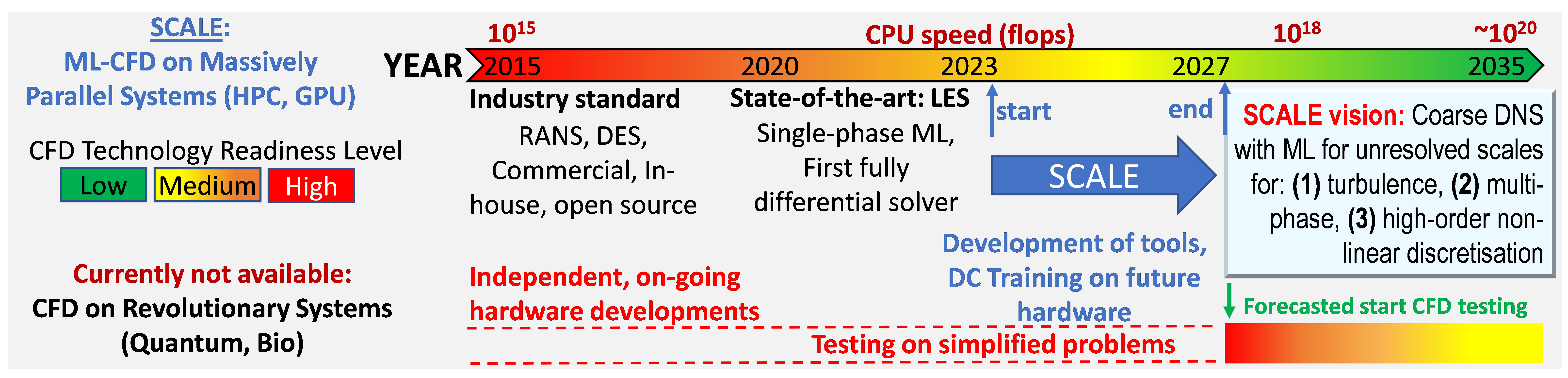
Illustration of today’s CPU speed, computing hardware, state-of-the-art CFD methods used by industry and academia and foreseen developments in this area, in relation to the timeline of SCALE
These promising developments have inspired the SCALE consortium to develop ML-CFD methods that can significantly reduce computational time and/or improve accuracy, when dealing with complex multiphase flows; a non-exhaustive list includes cavitation, supercritical fluids, and agglomerates formation, which are realised in numerous engineering/bioengineering applications. However, currently only a handful of studies where ML has been combined with multi-phase flows are available; relevant methods are largely missing from the literature.
The recruited Doctoral Candidates shall be among those specialising in this field. To achieve this aim, existing and new ML methods for CFD will be employed and generalised to address specific, yet generic enough characteristics of multiphase flow solvers.
Industrial applications addressed in SCALE: The development of ML-CFD tools that can significantly accelerate the design process across a range of different applications is the cornerstone of SCALE. These expand in the following areas:
(1) Hydraulic turbomachines: produce renewable energy but occurrence of catastrophic cavitation limits their operational envelope;
(2) Hydrodynamic propulsion: similarly, the occurrence of catastrophic cavitation must also be prevented;
(3) Decarbonisation strategies for transportation: for heavy duty, earth-moving machines and marine vessels, which are responsible for more than 15% of human-made global CO2 yearly, the renewable energy transition is still at an infant stage; a problem that is becoming more compulsive in the current geopolitical situation. H2-derived CO2-neutral synthetic fuels produced using renewable energy sources (e-fuels) in dual-fuel internal combustion engines (DFICEs) represent the most promising and immediate alternative.
(4) Pharmaceutical industries: out of the numerous applications, two examples are addressed here; (a) inhalation of medicinal drugs using dry powder inhalers (DPIs), a well-established technology for drug delivery to the lungs and (b) High Intensity Focused Ultrasounds (HIFU) used in localised cancer treatment;
(5) Additives: they are used across a wide range of products for cooling enhancement and drag reduction, as they alter the rheological properties of working fluids, introducing non-Newtonian flow effects.
(6) Heat transfer and thermal management concepts for electric motors (e-motors): accurate prediction of the complex aerothermal flow around the vehicle, or the cooling of the e-motor of passenger cars powered by Li-ion batteries are vital for developing efficient cooling concepts; technological advances developed and tested at the competitive F1 environment under extreme operating conditions can/are often transferred to the automotive sector.
Research related Work Packages
Work Package 1
To perform DNS simulations and utilise ML techniques to develop physics-informed wall closure models for: (1) boundary layers of non-Newtonian fluids without heat transfer; (2) acoustic ultrasound-induced PFC droplet vaporisation in brain micro-blood vessels leading to blood brain barrier (BBB) opening; (3) velocity and temperature boundary layers in complex 3D cooling configurations; and (4) thermal boundary layers with zero pressure gradient (ZPG) and adverse pressure gradient (APG)
PhD topics related to WP1
DC No | Topic |
1 | Consistent wall treatment for non-Newtonian flows via deep reinforcement learning |
2 | Acoustic PFC droplet vaporisation in blood vessels and NN optimisation of droplet dose for BBB opening |
3 | CNN-enhanced turbulent multi-fluid heat transfer in electrical devices |
11 | Physics-informed NN closures for RANS simulations of out of equilibrium non-isothermal flow |
Work Package 2: To perform high-fidelity LES and DNS simulations and utilise ML techniques to derive physics-informed and data-driven surrogate models for specific SGS processes relevant to: (1) inhaled drug particle’s agglomeration and de-agglomeration; (2) ultrasound-induced bubble cloud collapse over a solid surface, modelled as non-Newtonian fluid media; (3) shape optimisation framework for two-phase flows using real-fluid thermodynamic closure for the media properties; (4) turbulence-thermodynamic interactions for simulating mixing and combustion of multi-component e-fuels under supercritical fuel-fluid and air conditions in DFICEs; and (5) ultrasound-induced drug delivery applications considering multi-material cavitation acoustics
PhD topics related to WP2
DC No | Topic |
4 | AI accelerated simulations of particle agglomeration and de-agglomeration in inhaling drug delivery |
5 | Multi-fidelity bubble cloud collapses for medical ultrasound-induced tissue treatment |
6 | Adjoint Multiphase Shape Optimisation tool with an ML-accelerated Real-Fluid EoS- Applications |
7 | ML-enhanced monolithic LES modelling of thermodynamics-turbulence interactions in dual-fuel combustion |
12 | HIFU-induced compressible multi-material interactions for encapsulated microbubble drug delivery |
Work Package 3: To perform RANS and LES simulations and utilise ML techniques to derive data-driven models to enhance nonlinear discretisation schemes for: (1) isotropic turbulence in single and two-phase flows and application to marine propellers; (2) cavitating marine propeller designs process; (3) shape optimization frameworks for cavitating hydraulic turbines.
PhD topics related to WP3
DC No | Topic |
8 | ML-optimised LES approach for cavitation erosion prediction in hydraulic machinery |
9 | Deep Learning in Propeller Design Optimization |
10 | ML enhanced analysis and adjoint-based optimisation tools for cavitating flows in hydraulic turbines |